Beginner Piano Chords: Six Shapes Behind Most Songs
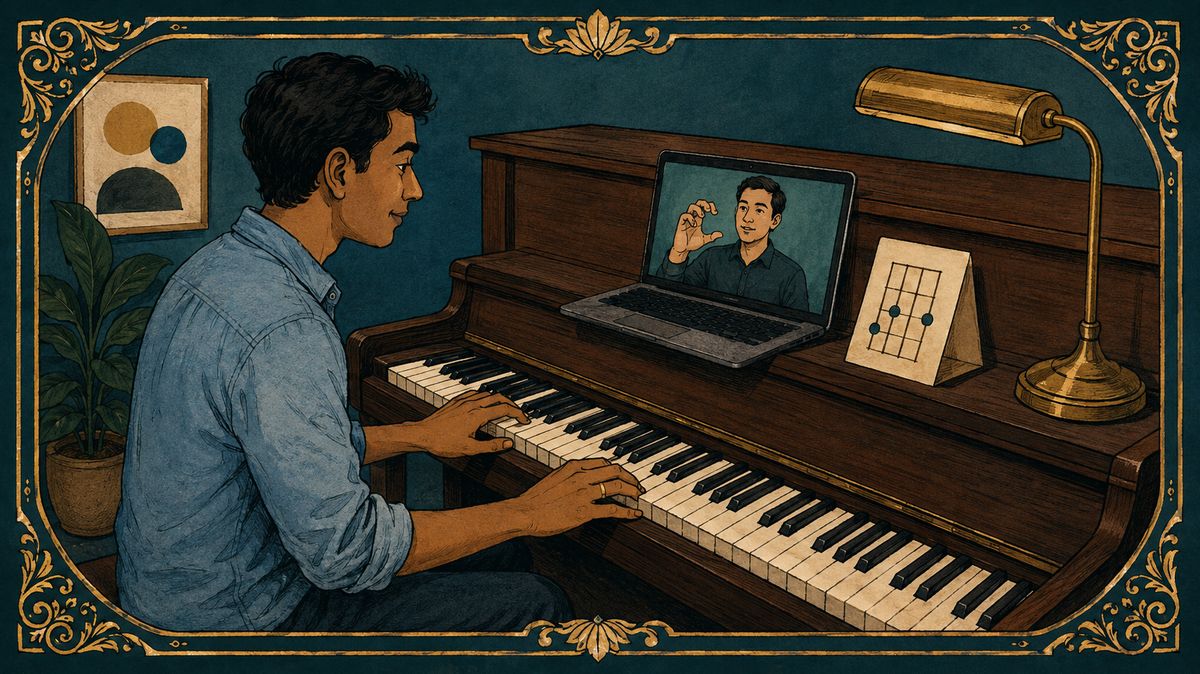
Most of the songs people want to play on piano are built from six chords. Not six hundred, six. C, F, G, A minor, D minor and E minor, all in the key of C, all played on white keys, all with the same hand shape. Learn those, learn to move between them in time, and you can play a large share of pop, folk, worship and singer-songwriter music from a lead sheet or a chord chart, with no reading beyond letter names.
This guide gives you the fingering for each, what it sounds like, the progressions that use them, and the practice that makes the changes automatic. If you have never sat at a piano, read our beginner piano tips first for posture and bench height, then come back.
The one hand shape
A basic chord (a triad) is three notes stacked in thirds: a root, a third and a fifth. On white keys that means play a note, skip one, play the next, skip one, play the next. In root position, with the root note at the bottom, your right hand uses fingers one, three and five: thumb, middle finger and pinky. Your left hand uses five, three and one. That is the fingering for all six chords below, and the shape never changes, only where it sits. Later in this guide you will rearrange those same notes into inversions, and because an inversion changes the spacing between the notes, the fingering changes with it. Those fingerings are given where the inversions are.
Keep the fingers curved and the wrist level, as if you are holding a small orange. Chords are where a flat, tense hand shows up fastest, and our piece on piano hand position has the checks worth running while you learn these.
The six chords
C major: C, E, G. Thumb on C, middle finger on E, pinky on G. Bright, settled, home. Almost every song in this key starts or ends here.
F major: F, A, C. Thumb on F. The same shape moved up three white keys: the thumb passes D and E and lands on F. Warm and open, the chord that feels like a chorus lifting.
G major: G, B, D. Thumb on G. Bright with tension; it wants to go back to C. Play G and then C and you will hear the sound of arriving home, the move that ends more songs than any other.
A minor: A, C, E. Thumb on A. The first minor chord. Same shape, but because of where the black keys fall between these notes, the gap from the root to the middle note is a half step smaller than it is in C major, and that smaller third is the entire difference between major and minor. A minor is the relative minor of C: it shares two of C major’s three notes and the same white keys, which is why the two keep each other company in so many songs.
D minor: D, F, A. Thumb on D. Darker, more dramatic than A minor, the chord that gives a progression somewhere to go.
E minor: E, G, B. Thumb on E. Soft, wistful, the minor chord that sits under a lot of ballads.
That is the whole set. Six positions, one shape. Spend a week playing each one, naming it out loud, and moving to the next, before you touch a song.
Hearing major and minor
One short ear-training exercise does most of the work here: play C major (C, E, G), then C minor (C, E flat, G), back and forth, slowly. E flat is the black key just to the left of E, the only black key you need for this exercise. Major sounds resolved and open. Minor sounds shaded. You are hearing one note, the third, drop by a half step and nothing else. C major against A minor is a different comparison: those two share two notes and change the root, which is why they sound like cousins rather than opposites. Once you can hear it, you will start hearing it in songs, which is when chords stop being shapes and start being meaning.
The progressions that use them
A progression is a sequence of chords that repeats. Four of them cover an enormous amount of music, and all four use only the six chords above.
C, G, A minor, F. Sometimes called the four-chord song. Let It Be, Someone Like You, With or Without You, Don’t Stop Believin’, Take on Me, and hundreds more sit on this exact loop or a rotation of it, each in its own key. Played in C, it is the four chords above, and the shapes carry to any key later. Learn this one first.
C, A minor, F, G. The 1950s progression. Stand by Me, Every Breath You Take, Earth Angel. Same chords in a different order, and it sounds fifty years older.
A minor, F, C, G. The four-chord song rotated to start on the minor chord, which is why it feels darker and more modern even though the chords are the same four and the key is still C. Play it straight after C, G, A minor, F and you will hear how much the starting point changes. A large share of what sounds minor on pop radio is this loop.
D minor, G, C. The two-five-one, the move that jazz is built on and that turns up in pop as a turnaround. Play it slowly and hear how D minor leans into G and G falls into C.
Play each progression in the right hand only, four beats per chord, with a metronome around 70. When that is boring, add the root note of each chord in the left hand: C under C major, G under G, A under A minor, F under F. That single left-hand note is the difference between an exercise and a song.
Making the changes smooth
Beginners lift the whole hand and land it on the next chord like a stamp. That works, but it is slow and it sounds like a stamp. The fix is inversions: the same three notes in a different order.
Every triad can be played three ways. C major is C, E, G, but it is also E, G, C (first inversion) and G, C, E (second inversion). The notes are the same, the chord is the same, and the hand barely has to move. Going from C to F, keep the C where it is at the bottom and play F as C, F, A, low to high. Going from C to G, keep the G on top and play G as B, D, G. Your hand travels one or two keys instead of three or four, and the progression sounds connected instead of jumpy.
An inversion spreads the same three notes differently, so the fingering moves with it. Find the wide gap, which is always a fourth, and cover it with the wide gap between your fingers. F played as C, F, A has that fourth at the bottom, C up to F, so the right hand plays it one, three, five and the left hand plays it five, two, one. G played as B, D, G has the fourth on top, D up to G, so the right hand plays it one, two, five and the left hand plays it five, three, one. Root position stays one, three, five in the right hand and five, three, one in the left. Those three shapes cover every chord in this guide, and forcing the root-position hand onto an inversion is what makes chords feel like a stretch.
Learn the inversions one chord at a time, up and down, before you use them in a progression. It is one of the most useful weeks of practice a beginner can spend on chords.
From chords to songs
With the six chords and the four progressions, a lead sheet becomes readable: the letters above the words tell you what to play, and the shape in your hand tells you how. Our 30-day path to a first piano song uses exactly this route, and why music theory matters explains, without the textbook, why knowing six chords by ear beats knowing sixty by sight.
Two things a teacher adds here that are hard to get alone. The first is rhythm in the left hand: broken chords, an alternating bass, a simple pattern that makes a song sound like the record instead of like a hymn. The second is the seventh chords, the sus chords and the one black-key chord (usually B flat) that a given song needs, added exactly when your hands are ready and not before. Our guide to online piano lessons for adults covers how that pacing works over a screen, and if you are learning on a tablet app first, our honest guide to that explains where the app stops and a teacher starts.
How to Find a Piano Teacher on Tunelark
Tunelark connects you with deeply vetted piano teachers who teach online. Vetting is run by working musicians and music teachers, not a general recruiter, and every teacher sets their own rate and shows it on their profile. Scheduling, billing and support are handled for you.
- Browse piano teachers at tunelark.com/find-a-teacher and look for teachers who mention pop, songwriting, chords or playing by ear.
- Watch their videos to hear whether they explain what a chord is doing, not just where it is.
- Book a trial lesson at $25 off the teacher’s 30-minute rate and bring a song you want to play.
- Ask yourself afterward whether you left with a progression to practice, not a page of exercises.
Frequently Asked Questions
What are the first chords to learn on piano?
C major, F major, G major, A minor, D minor and E minor. All six use white keys only and, in root position, the same finger shape of thumb, middle finger and pinky, and between them they cover most pop and folk songs in the key of C.
What is the easiest chord progression on piano?
C, G, A minor, F, four beats each. It is the loop under Let It Be and hundreds of other songs, and it uses the same hand shape moved to four positions.
How do I make piano chord changes faster?
Learn inversions. Playing the next chord in whichever order of notes is closest to your hand cuts the movement to one or two keys, which is what makes changes smooth at tempo. The fingering shifts with the shape, so learn each inversion with the fingering that fits it rather than forcing the root-position hand onto it.
Should I learn chords or scales first on piano?
Chords, if your goal is songs, because chords get you playing recognizable music within weeks. Scales build the technique that lets you play melodies over those chords, and a teacher will introduce them alongside.
Do I need to read music to play piano chords?
No. Chord charts and lead sheets use letter names above the lyrics. Reading the staff comes later and opens up classical music and written arrangements, but the six chords here need only the letters.
Looking for an online piano teacher? See our full Online Piano Lessons page for everything you need to know about getting started.
Keep reading
About Jennifer Heath
I'm Jennifer Heath, VP of Operations at Tunelark and a lifelong singer. I joined the company in 2020 and oversee much of what makes Tunelark work for students and teachers: hiring, training and supporting our instructors, student support, marketing and day-to-day operations. I started voice lessons at 7 and sang with touring choirs through my teens. Music belongs in every life, for the self-expression, the discipline, the comfort and the simple joy of it.