Online Music Teaching Curriculum Design: Sequencing for Remote Instruction
Curriculum design is the skill that separates teachers who produce durable progress from those who fill lesson time. In person, you can compensate for a thin plan with tactile correction, physical demonstration, and a constant read of the student’s body. Online, the slow feedback loop and the camera between you make weak sequencing show up faster, and it makes strong sequencing pay off more visibly. What follows is a working method for designing music curriculum that holds up under remote conditions: how to structure the long arc, how to sequence foundations per instrument, how to set difficulty deliberately, and how to know when the plan needs to change.
What Remote Conditions Demand of a Curriculum
Three structural facts about online teaching should shape every sequencing decision you make.
Recovery from a wrong assignment is expensive. In a shared room you can rescue a too-hard piece mid-lesson by physically resetting a hand or a bow arm. Online, an over-pitched assignment costs a full week of frustrated home practice before you even see the damage, then more lesson time to unwind it. The cure is prevention through tighter sequencing, not faster correction.
The student studies alone, with whatever you sent. Between lessons the student works from your PDFs, your recordings, and your written notes, with no live voice to clarify an ambiguous marking. Materials have to be self-explanatory: fingerings written in, tempo targets stated, a reference recording linked, and a one-line “what success looks like this week.” This is why teachers moving from a studio to a screen, covered in the shift from in-person to online teaching, have to formalize what used to be improvised.
Momentum has to be engineered, not felt. Online students lack the ambient sense of progress that a physical studio provides. A curriculum that produces a visible, nameable milestone every three to four weeks (a finished piece, a passed scale set, a recorded performance) does the motivational work the room used to do. Designing for those checkpoints is the core of keeping remote students engaged over the long term.
The Three-Layer Arc: Long, Medium, Weekly
Every strong curriculum runs at three time scales at once, and the teacher keeps all three legible to the student.
Long arc (1 to 3 years). The destination. A classical pianist might be aimed at the Clementi sonatinas and the easier pieces from the Anna Magdalena Bach notebook, with a Bach Two-Part Invention as the stretch for the fastest learners. A jazz pianist might be aimed at comping from lead sheets and building chord-melody arrangements. A singer might be working toward a recital set spanning an art song, a music-theater number, and a contemporary piece. The specific destination matters less than having one that the repertoire and technique both point at.
Medium arc (one grade level, typically six months to a year). This is where published syllabi earn their keep, because they have already solved the sequencing problem for you. A medium arc anchored to RCM Level 4 or ABRSM Grade 3 gives you a defined repertoire list, required scales and arpeggios, sight-reading expectations, and an ear-training component, all calibrated to sit together. You do not have to use the exam. You can borrow the grade as a ready-made plan for the next six months to a year. Trinity’s syllabus is useful here too because it lets the student choose more of the list, which suits adult learners who want agency.
Weekly arc. What this lesson targets and what next week’s practice should produce. This is the only layer most under-designed curricula ever operate at. The fix is to make every weekly assignment trace upward: this scale serves this piece, this piece serves this grade, this grade serves the long arc. When the student can see that chain, practice stops feeling like disconnected homework.
Sequencing Foundations First, Per Instrument
Nearly every instrument has a non-negotiable foundation phase that should be sequenced before, or interleaved with, anything the student requests. Skipping it to jump straight to favorite songs is the single most common curriculum mistake, and online it is punished hardest, because a student building bad habits at home is unsupervised between lessons.
Piano. Hand position and a neutral wrist, note reading across both staves from the start (not treble-only for months), five-finger patterns, then C, G, and F major scales with correct fingering, leading into a graded method such as Faber’s Piano Adventures or the Alfred series. Build to first real repertoire with Burgmüller’s Op. 100 studies, which are short, musical, and each drill one technical idea.
Voice. Posture and breath management first, then a comfortable middle-range tessitura before extending up or down, basic registration awareness, and clean vowel formation on sustained tones. Early repertoire should sit inside the comfortable range: simple folk songs, easy art songs in English, then the 24 Italian Songs and Arias once the instrument is stable. Range extension is sequenced last, not first.
Guitar. Open-position chords first, meaning C, G, D, E and A major plus A minor, E minor and D minor, with clean fretting and a relaxed strumming hand, then common progressions (I-IV-V, I-V-vi-IV) so the student can accompany dozens of songs immediately, then fingerstyle patterns. C minor and G minor belong much later, because neither has an open-position form and both need a barre. The CAGED system comes later, once barre chords arrive, because its job is to turn those five shapes into movable forms up the neck rather than to group the open chords a beginner is learning. Standard notation can be introduced alongside tab rather than instead of it.
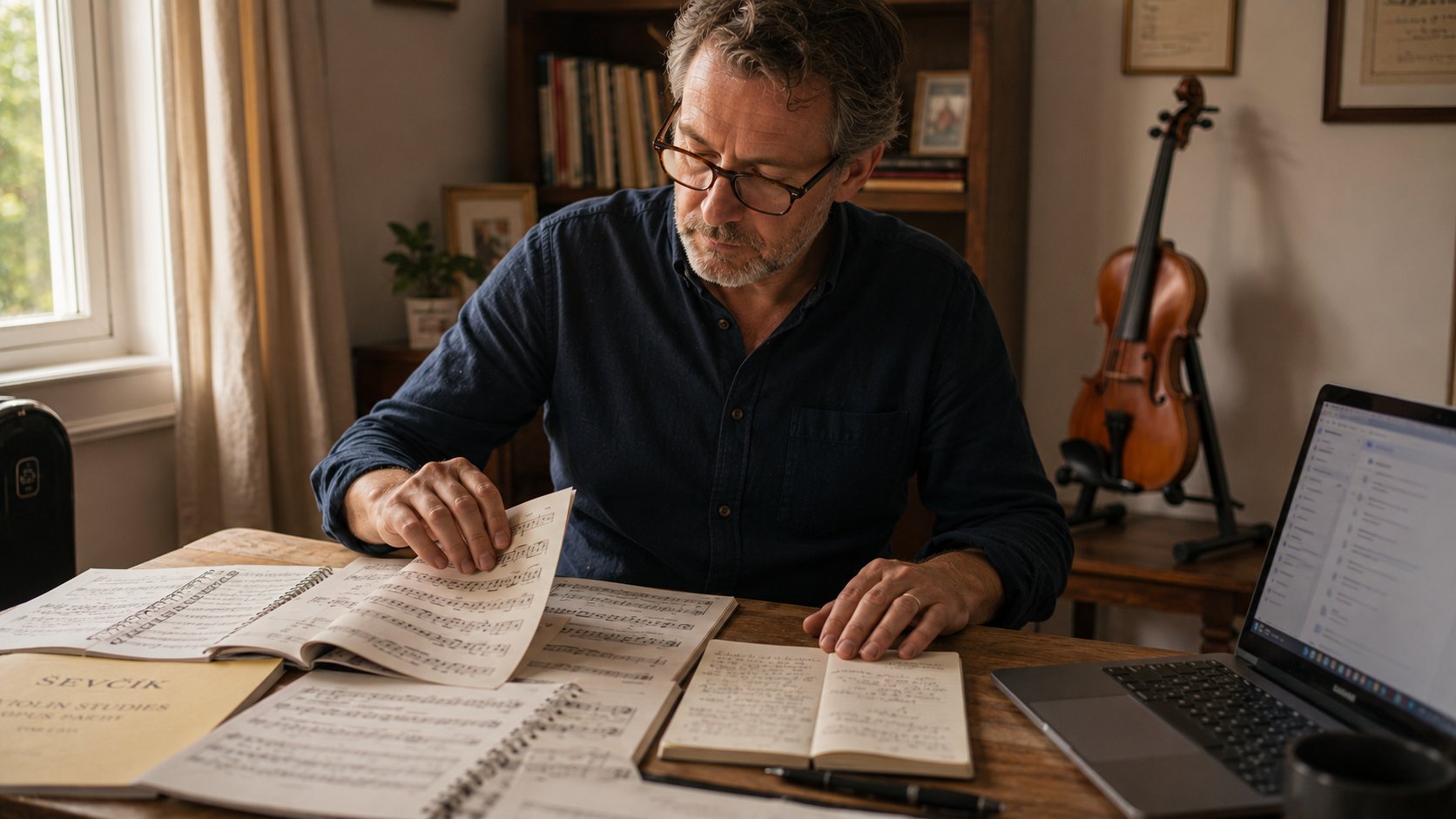
Strings (violin shown). Bow hold and instrument posture before any pitch work, open-string bowing for tone and straight-bow tracking, first-position fingering on one string at a time, then across strings, with intonation checked against open-string resonance. The Suzuki repertoire sequence is the most widely used and is correctly understood as a repertoire ladder; pair it with a note-reading track, since Suzuki’s ear-first approach can leave reading thin if you do not add it deliberately.
The point of foundations is not delayed gratification. A good plan sequences foundation work alongside simplified arrangements of music the student actually loves, so the technique has an immediate payoff. That integration is what sustains motivation through the slow early months.
Setting Difficulty on Purpose
Effective curriculum holds the student in a zone of productive difficulty, close to what Vygotsky described as the zone of proximal development: hard enough to demand focused effort, easy enough to be finishable inside the student’s real weekly practice time. That is a different idea from the desirable difficulties in the learning-science literature, which are specific training moves such as spacing practice out, interleaving skills, and testing recall, and which make practice feel harder in the moment while improving what the student keeps. Too easy breeds boredom and slow gains. Too hard breeds frustration, then the quiet decision to quit.
A working ratio makes this manageable. Neither idea prescribes a numerical split, so treat the numbers below as a rule of thumb many teachers find workable rather than a research finding: roughly 70 to 75 percent of weekly assigned material should sit solidly inside the student’s current ability (review, consolidation, polishing, anything they can already mostly do), and only 25 to 30 percent should genuinely stretch beyond it. Pure stretch work with no grounded majority is exhausting and unsustainable, and it is the usual hidden cause of practice collapse. This ratio also respects how home practice actually works; the consolidation portion is where the gains in a 15-minute-a-day practice habit get banked, while the stretch portion is what the next lesson advances.
When a student stalls on stretch material, the instinct to double down is usually wrong. The productive move is to step back one rung, build the specific missing competency in isolation, and return to the hard material with the gap filled. A persistent stall is often a plateau with a diagnosable cause rather than a motivation problem.
Sequencing Choices That Work Especially Well Online
A handful of deliberate decisions make a curriculum more robust under remote conditions.
- Teach reading early and keep it on the weekly menu. Fluent readers can prepare new pieces between lessons without you, which is exactly the autonomy online study rewards. Pair reading with a working grasp of why music theory belongs in lessons, so the student understands the patterns rather than decoding note by note.
- Build technique inside repertoire. Instead of a separate “exercises” silo, choose pieces that drill the next technical priority. A Burgmüller study for left-hand independence, a specific song for barre chords. Integrated technique sticks better and feels less like a chore on screen, where tedium reads louder.
- Standardize digital materials. A shared folder of PDFs, linked reference recordings, and a running notes document per student outperforms physical sheet music for asynchronous study, because the student always has the current version on the device they practice with.
- Schedule performance moments. A recording for family, a planned end-of-term online recital, a quick send-me-a-take checkpoint. Performance forces a consolidation that open-ended practice never produces, and it converts the milestone into something the student can feel.
- Rotate skill domains. Cycle weekly attention across repertoire, technique, sight-reading, ear training, and free play. Teachers consistently find that students whose online lessons touch only one dimension lose interest faster than students with a varied weekly focus, which is practitioner experience rather than a measured comparison.
Adapting the Plan to the Student
The same content needs a different shape depending on who is in front of the camera.
Adult beginners need a slightly slower foundation phase, explicit reasoning for every choice (adults practice better when they understand why), and repertoire tied to music they love. Set realistic timelines, and help them build a practice routine that fits an adult schedule rather than assuming open afternoons.
Returning players need a fast diagnostic first: assess what survived and what faded, remediate the specific gaps, and move back to advanced material far quicker than a true beginner. The risk is boring them by treating them as beginners; the fix is targeted remediation, not a full restart.
Children need shorter focus blocks per topic, more physical play and exploration, a reward-shaped progression (passing pieces, recital prep, level badges), and parent communication built directly into the design, since the parent is the home-practice enforcer.
Advanced students need specialization choices (period, style, instrument family), genuine self-directed elements, and longer arcs with higher technical ceilings. Here the syllabus becomes a floor to clear, not a destination.
What Leaving the Plan Actually Looks Like
Adapting by student type is design work you do in advance. The other kind happens in the lesson, when the plan meets a particular Tuesday. Two Tunelark teachers describe the same decision from opposite instruments.
Tony G. teaches guitar. A teenage student of his, also playing with School of Rock, arrived mid-way through a technique unit needing his parts for a song by The Who by the weekend. The scales waited. They spent the lesson breaking the song down and getting him ready for rehearsal, and Tony treats that as the point rather than the exception. Holding to the planned route was never the aim, he says. The aim is a better musician, and some weeks that takes a change of direction.
“To me, that’s one of the advantages of personalized instruction.”
The design consequence is in what happens next. In his experience the detour lasts a lesson or several weeks, and a student who stays long enough almost always circles back to the material that was put on hold, arriving at it more motivated because they have just used those skills for something real.
Mary Beth S. teaches voice, where the thing that varies is the instrument itself. For her the departure is not an event, it is the baseline:
“A personalized lesson plan in vocals is a daily endeavor for every singer.”
Her reason is physical rather than pedagogical. The vocal cords are part of the body, so weather pressure, muscle tension and a stress response that inflames the throat all arrive in the lesson whether the plan accounts for them or not. Her first move each week is therefore diagnostic rather than curricular. She knows what each student normally sounds like, and reads the gap:
“This student is rarely pitchy, so I start looking for clues to tension when I do hear it.”
Where that leads on a given day is often stretching, or breathing, or a conversation, and none of it is on any plan.
A curriculum that cannot survive that is the wrong curriculum. Design the arc so any single week can be spent elsewhere without breaking the sequence, keep the dependency between units explicit so you know what a detour actually costs, and write the weekly layer loosely enough that a five-minute check-in can redirect it. The long arc is the promise. The week is negotiable.
Knowing When to Revise
Curriculum is a living plan, not a document you write once. Review each student’s medium arc roughly quarterly, and revise immediately when any of these signals appear:
- The student has been on the same piece or concept for several weeks with no measurable progress.
- Practice has dropped off and the student cannot say why.
- The student is bored even though the material is appropriately challenging (a sign the stretch portion is too small, or the wrong kind of stretch).
- The student is overwhelmed even though the material is correctly scaled (often a practice-strategy problem, not a difficulty problem).
- The student is asking for something the current plan does not address.
Each signal points to a different fix, so name the cause before you change the plan.
Building a Reusable Leveled Curriculum Library
The leverage in curriculum design comes from not rebuilding it per student. Over time, assemble a library you can draw from:
- Leveled repertoire ladders for each student path you teach (classical piano, pop guitar, music-theater voice), with three to five pieces banked per level so you have alternatives when one does not fit.
- A graded set of technical exercises, each tagged with the skill it develops, so you can prescribe by need rather than by memory.
- Theory and ear-training units paired to specific repertoire, so the concept arrives exactly when a piece demands it.
- Standard practice templates per level, which double as the home-practice instructions you hand the student.
- Student-type starter plans (adult beginner, returning teen, young child) you can adapt in minutes instead of designing from scratch.
Most teachers accumulate a library like this by accident, spread across a career. Building it on purpose, anchored to a public syllabus so the leveling is consistent, gets you there in a fraction of that time and makes every new student faster to onboard. The discipline that strong remote curriculum demands is exactly what makes online teaching competitive with in-person work, and it tends to make you a sharper teacher in every format.
How Tunelark Vets Its Teachers, and Why It Matters for You
Every Tunelark teacher is vetted by working musicians and educators for teaching quality before they can list. The bar: a music degree, at least two years of teaching experience, a background check Tunelark runs, a performance sample, a live teaching sample, credential verification and former-student testimonials, all reviewed by working musicians. The detail lives on the teach with Tunelark page.
How to Become a Music Teacher on Tunelark
Tunelark is a marketplace. Students browse Find-a-Teacher and choose for themselves, and we never touch your curriculum: the arc, the repertoire and the materials stay yours.
1. Apply to teach and submit a short profile.
2. Share a brief introduction along with a sample of your playing and your teaching.
3. Our team of experienced musicians and teachers reviews applications and follows up with teachers who meet the bar. We keep the roster selective on purpose.
4. Once you’re approved, you set your own rates, availability, and lesson approach, and we handle scheduling, billing, payments, and student discovery around you.
Tunelark works best for experienced teachers who care about long-term student relationships and want a platform that respects both their time and their craft.
Frequently Asked Questions
Do I need a different curriculum for online versus in-person students?
The content is largely the same. What changes is how much of it has to survive without you in the room, so the practical test is whether the student could open this week’s assignment alone and know exactly what to do. The checklist under What Remote Conditions Demand of a Curriculum sets the standard. If any item on it is missing, the assignment is not ready to send.
Should I follow a published method or syllabus like Suzuki, RCM, or ABRSM?
Use one as scaffolding, especially early in your career, and treat the choice as a question about the student rather than about the brand. RCM and ABRSM give you the tightest calibration when a learner wants a clear ladder to climb. Trinity suits students who want a real say in the repertoire. Suzuki is a repertoire ladder rather than a full syllabus, so pair it with a separate reading track. You are borrowing six months to a year of somebody else’s sequencing work, not committing anyone to an exam.
What is a good ratio of review work to stretch work in weekly assignments?
Roughly three quarters grounded and one quarter stretch, as the section above sets out. The more useful question is what to do when the balance slips. If the student is practicing and nothing is improving, the stretch portion is probably too large. If they are bored and still practicing well, it is too small. Move it one week at a time and watch what the next practice report does.
How do I integrate student-chosen songs with structured foundations?
Sequence simplified arrangements of the songs they love alongside foundation work rather than after it, and choose those arrangements to drill the exact technique you want next, such as a song built on the chords you are teaching that week. The motivation from playing music they care about compounds with the technical gain, instead of competing with it.
How often should I review and adjust a student’s curriculum?
Quarterly for the medium arc, and immediately whenever a signal appears. The mistake worth avoiding is changing the plan before naming the cause, because a stall, a drop in practice, boredom and overwhelm all look identical from the outside and each one needs a different response. Ask the student what the practice week actually looked like before you rewrite anything, and the answer usually arrives in a sentence.
Keep reading
About Jennifer Heath
I'm Jennifer Heath, VP of Operations at Tunelark and a lifelong singer. I joined the company in 2020 and oversee much of what makes Tunelark work for students and teachers: hiring, training and supporting our instructors, student support, marketing and day-to-day operations. I started voice lessons at 7 and sang with touring choirs through my teens. Music belongs in every life, for the self-expression, the discipline, the comfort and the simple joy of it.